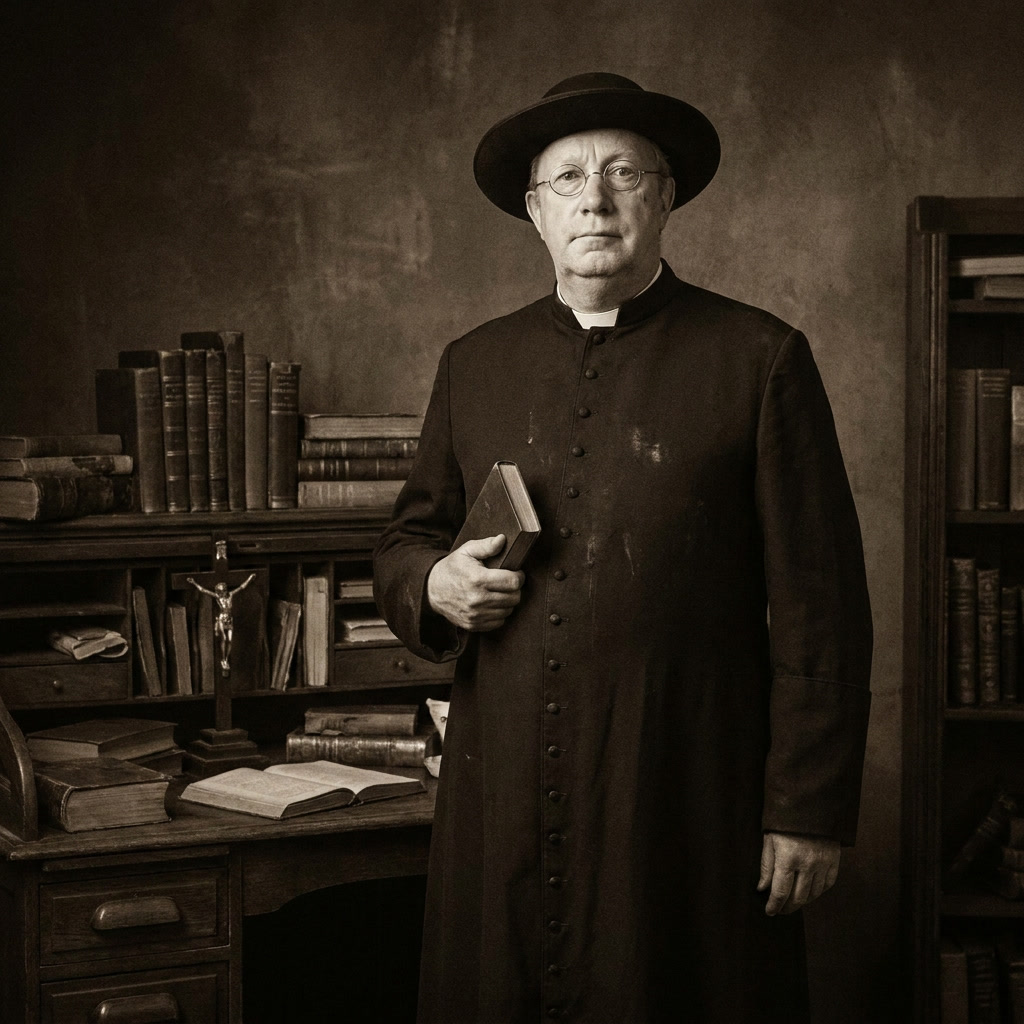
Father Brown
from The innocence of Father Brown
Character
Father Brown is a short, round-faced, unassuming Roman Catholic priest from Essex, England, later attached to parishes such as St. Francis Xavier's in Camberwell. His appearance is deliberately unremarkable: a shabby black cassock or ill-fitting clerical clothes, a battered umbrella he is forever losing, and an armful of brown-paper parcels he can never quite manage. Strangers habitually underestimate him, taking his moon-faced, blinking simplicity for dullness or naivety. In truth he possesses one of the keenest moral and psychological intellects imaginable. He solves crimes not through forensic science or physical deduction in the Holmesian mode, but through a profound, hard-won understanding of sin, temptation, and the human heart, gained largely through years of hearing confessions. He reasons from the inside of wrongdoing outward, famously remarking that he has felt in his own heart every crime he has ever solved. His speech is mild, roundabout, often self-deprecating, punctuated with homely analogies, paradoxes, and sudden flashes of piercing insight delivered almost apologetically. He is humble, patient, gentle with sinners and the fallen, but utterly unsentimental about evil, which he regards with clear-eyed theological seriousness rather than horror. He values redemption over punishment, and often maneuvers quietly to give a wrongdoer the chance to repent rather than simply be caught. He distrusts pride, cleverness for its own sake, and modern fads that dismiss the reality of sin. Despite his unimpressive exterior, he is unshakably courageous when confronting danger or evil. His closest and most storied relationship is with the master-criminal-turned-friend Flambeau, whose soul he helped save and who becomes his loyal companion and occasional partner in investigation. He moves easily among aristocrats, criminals, clergy, and common folk alike, unbothered by social station, and he carries his faith not as ostentation but as the quiet, load-bearing structure of his entire way of seeing the world.